
Garage Decluttering

Hazardous items handled correctly

Paint, oil, chemicals, gas bottles, batteries and fluorescent tubes from garages kept out of general waste and taken to the right facility.

In short: Hazardous garage items such as paint, motor oil, garden chemicals, car batteries, fluorescent tubes and gas bottles must be kept separate from general waste and taken to an appropriate facility, recycling centre or back to the supplier. Handling them correctly protects your household, waste workers and the environment, and keeps you within the law. Disposal is usually priced by quantity on top of the clear-out.

Get a free quote

Fixed price, no obligation. We aim to reply the same day.

By sending this form you agree to be contacted about your enquiry. See our privacy policy.

Hazardous items handled correctly

Garages collect hazardous items more than any other part of the home: half-used tins of paint and wood treatment, old engine oil, antifreeze, weedkillers and pesticides, car batteries, fluorescent tubes, aerosols and gas bottles. These cannot be mixed with general waste. Some are classed as hazardous waste in law, and others, like gas bottles, are dangerous if crushed in a waste vehicle.

We set these items aside at the start of the job, check containers are sealed and labelled, and keep them upright and separate during transport. Where we can take them to a suitable facility, we do. Where we cannot carry a particular item, we tell you exactly where it should go, whether that is your household recycling centre, a community scheme or the original supplier.

What is included

  • Identifying and setting aside hazardous and special items at the start
  • Checking containers are sealed, upright and labelled where possible
  • Separating paint by type, such as water-based and solvent-based
  • Taking oil, batteries and suitable chemicals to appropriate facilities
  • Advising on gas bottle returns to suppliers or stockists
  • Sending fluorescent tubes and electricals to WEEE recycling
  • Flagging suspected asbestos without disturbing it

Who it is for

  • Garages with old paint, varnish and wood treatments
  • Car enthusiasts with oil, batteries and fluids
  • Gardeners with old weedkillers and pesticides
  • Clearing a relative's garage where products may be decades old
  • Garages with old gas bottles from barbecues or heaters

How much does it cost?

As a guide, hazardous items are usually priced by quantity on top of the clear-out, from a small charge for a few tins to more for large amounts of chemicals. Taking small quantities to your recycling centre yourself is often free for householders. See our full cost guide.
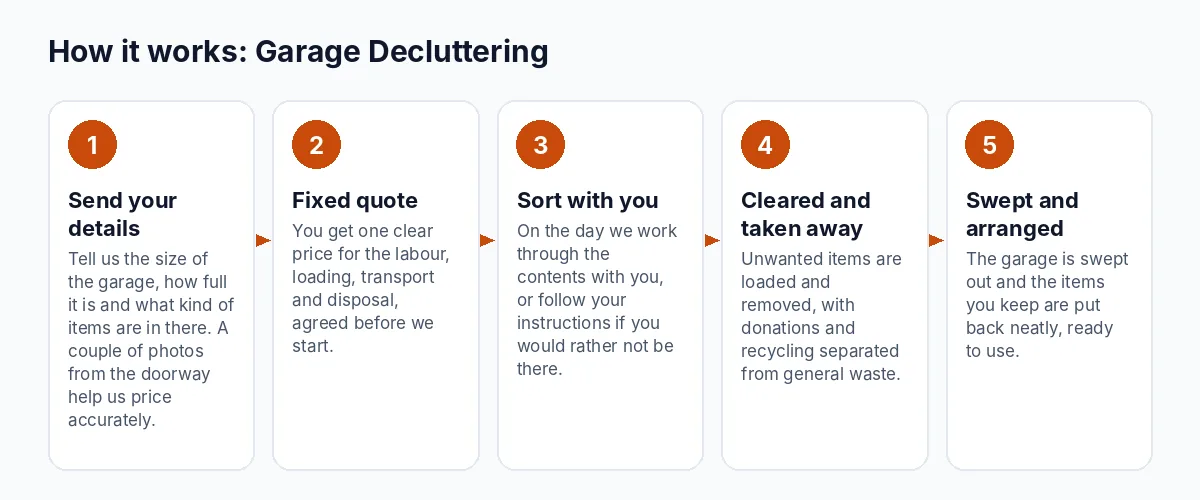
How it works

How hazardous items handled correctly works, step by step
  1. Identify

    Hazardous items are found and set aside before any general clearing so they are not crushed, spilled or mixed with other waste.

  2. Check and package

    Containers are checked for leaks, kept upright and grouped by type for safe transport.

  3. Route correctly

    Each item goes to the right facility, or we give you clear advice where we cannot take it.

  4. Record

    Hazardous items removed are noted so you know what has gone and where.

Hazardous items handled correctly: FAQs

Can I put old paint in the bin?

Liquid paint should not go in the household bin. Many councils say small amounts of water-based paint can be dried out, by leaving the lid off or mixing with sawdust or a paint hardener, then put in general waste once solid. Solvent-based paint, varnish and wood treatments are hazardous and should go to a household waste recycling centre. Check your council's rules.

What should I do with old gas bottles?

Gas bottles should never go in general waste or a skip, because they can explode if crushed. Most refillable cylinders remain the property of the supplier and can be returned to a stockist or the supplier. Some recycling centres accept disposable camping gas canisters. If a bottle is damaged or unknown, keep it upright outside and ask the supplier for advice.

How do I dispose of old garden chemicals?

Old weedkillers, pesticides and fertilisers should be kept in their original containers with labels and taken to a household waste recycling centre that accepts household chemicals. Never pour them down drains or onto the ground. Some products found in older garages have since been banned, so if a container is unlabelled or unknown, do not open or mix it, and ask your council.

What if there is asbestos in the garage?

Asbestos was used in many garage roofs, wall panels, flue pipes and some old floor tiles before 2000. If it is in good condition and left undisturbed, it is low risk. Do not break, drill or sweep it. Loose asbestos debris or damaged sheets need specialist handling. Some council recycling centres take small amounts of bagged asbestos cement by appointment, so check locally first.

Get a quote for hazardous items handled correctly

Send a few details and get one clear, fixed price, usually the same day.

Get a quote

Last updated 6 November 2026